
Solar System - Sketching & Size & Scale (Continues)
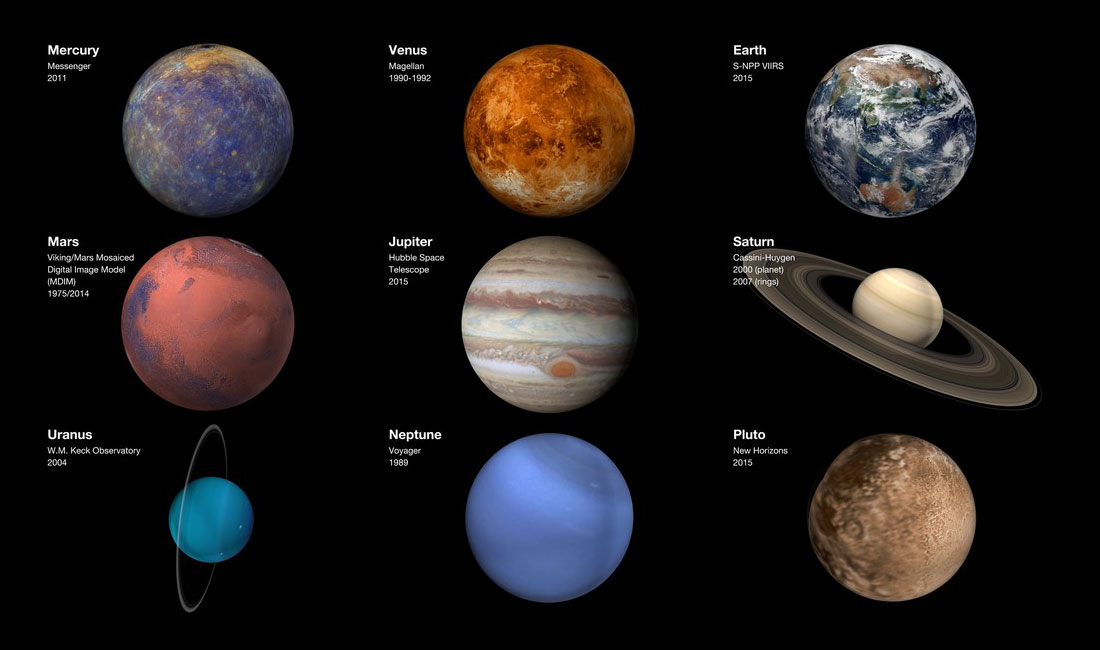
OPENING QUESTION:..Please sort your planet tiles in *size* order
OBJECTIVE: I will work with my team to note additional planetary details on our chart during today's class.
WORD FOR TODAY:
- Sol ("Our Sun")
- Asteroid ("Rocks in space" otherwise known as "Flying Potatoes" )
- Comet ("A dirty snowball")
- Meteor ("Rocks falling to Earth")
- Moon ("A rocky body orbiting a planet")
- Planet ("A spherical body orbiting a star")
- Mercury
- Venus
- Earth
- Mars
- Jupiter *(has rings!)
- Saturn *(has rings!)
- Uranus *(has rings!)
- Neptune *(has rings!)
- Dwarf Planet:
- Pluto
- Eris
- Haumea
- Astronomical Unit (1 AU = 150,000,000 km = ~ 100,000,000 miles)
WORK O' THE DAY:
What are asteroids, and why do we care (and we *do* care!)
═════════════════════════
If we were to do a search on 'city killer' asteroid we'd get a massive mix of screaming headlines. Let's see what NASA has to say.
Now please work with your team to add the 'asteroid' belt to your charts. While you are doing that, have a team member research the 5 largest asteroid(s). Are they worth adding to our chart? Why or why not?
Let's discuss.
═════════════════════════
Now let's switch gears a bit:
Our little bitty "Sol"ar System is pretty tiny when viewed on the scale of the Universe or even our own Milky Way Galaxy.
At the same time, it is pretty massive when compared to human scales of distance and time to get there. Ask one of our AI wizards for the shortest time travel using current technology to get to each planet (keeping in mind that for much of each planet's orbit around the sun it is on the opposite side of the sun which will effectively DOUBLE the time it would take to get there)
Now label that time-to-travel right there on the chart for each planet as well as for Ceres, which as we just learned is in fact a 'Dwarf Planet'.
When you are finished, please tape your posters up on one of the white boards and we'll have a 'gallery walk' to compare!
═════════════════════════
Now that we have some practice in size and scale, let us GREATLY expand our understanding of the size and scale of our solar system by creating a new chart to include the following (also, please do a wee bit of research on each):
Dwarf Planets (how does a 'dwarf planet' differ from a 'normal' planet?):
- Haumea
- Pluto, Charon
- Makemake (This object was found in 2005 by an observer using the 200" Palomar Observatory reflecting telescope at Mt Palomar in California. Because it was found so close to Easter it was named for the God/Creator of Easter Island. The correct Polynesian pronunciation is "Mah-kay Mah-kay")
Comet Clouds:
- Kuiper Belt
- Oort Cloud
Voyager 1 Spacecraft (please add this too!)
═════════════════════════
The Voyager 1 and Voyager 2 spacecraft have been in flight since my high school days (mid 1970's). They are currently making their way through the Kuiper Belt)
Voyager I:
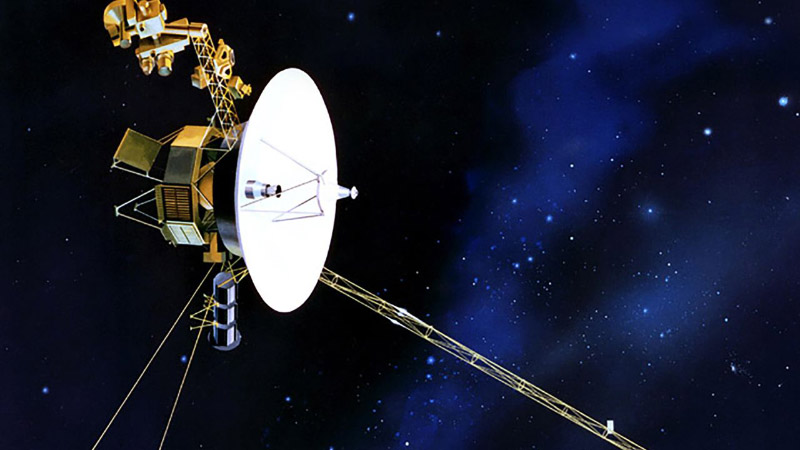
Current Flight Time: (launched September 5, 1977 so right at 47 years)
Current Speed: 17 km/second! (10.5 miles/sec)
Current Distance from Earth: 24.4 billion km
Onboard Computer Processing Speed: 8,000 instructions per sec (my laptop processes about 1.5 *billion* instructions per second)
Onboard Computer Memory: 70 kilobytes (my laptop has 16 billion bytes of memory)
Onboard power supply: Radio-Thermal Generator (RTG) output = 470 Watts at launch, around 300 watts now (a regular ol' table lamp light bulb is usually around 100 Watts). The radio transmitter that communicates with NASA's Deep Space Network uses about 100 Watts.
Propulsion System: None. There are small jets used to maneuver the spacecraft. They were fired up in 2017 for the first time since 1980!)